About Nyacol

Applications

Information

Distributors/Reps

White Papers

Site Map

Technical Support

What's New

What's New


Home Page


Nonaqueous Dispersions of Colloidal 
Antimony Pentoxide Flame Retardant Additives

NYACOL® APE1540        NYACOL® AB40

Nyacol Nano Technologies, Inc. offers a nonaqueous colloidal antimony pentoxide dispersion as a synergist with halogenated flame retardants for use in unsaturated polyester and vinyl ester resins.

Advantages over a conventional antimony trioxide system: 

·          Greater surface area for faster halogen reactivity on burning.

·          Less potential health hazards through dust-free handling.

·          Much less wear on pumps, valves and nozzles.

·          Better penetration into the structure for improved dimensional consistency and no "spongy laminate" feel.

·          More chemically resistant.

·          Non-pigmenting for translucent composite or enhanced mass tone colors.


Form

NYACOL® APE1540 and NYACOL® AB40 flame retardant additives are dispersions of nano-sized (colloidal) antimony pentoxide particles in a liquid isophthalic polyester resin. The oxide particles are nearly 1/100 the size of powdered antimony trioxide. 

Function 

Both NYACOL® APE1540 and NYACOL® AB40 are non-settling antimony dispersions for use as a flame retardant synergist in halogen-containing polyester and vinyl ester resins.  APE1540 is used with room temperature cure systems using cobalt-MEKP type cure systems.  AB40 can be used in high temperature cure systems or with disubstituted peroxide cure systems.  APE1540 or AB40 can be substituted for antimony trioxide in formulations involving any polyester or vinyl ester resin system containing bromine or chlorine.  Both APE1540 and AB40 have been used in epoxy coating systems.
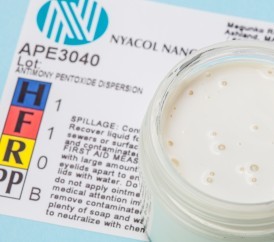
Using antimony trioxide in critical corrosion resistant applications always results in totally opaque laminates.  Nyacol dispersions can enhance quality control.  The fine particles are nearly invisible, allowing in-process and final inspection with the same degree of confidence as non-FR laminates.

The Nyacol dispersions can be added to the resin with simple stirring.  They will not settle and concentrate at the bottom of the container.  In filament winding operations, APE1540 assures more reliable operation without settling in the resin trough.  Total labor cost savings in mixing and fabrication can be significant.

Products

Typical Properties

* antimony oxide expressed as Sb2O5

Grade

APE1540

AB40

Form

Viscous liquid

Viscous liquid

Colloidal antimony oxide *

40% by weight

40% by weight

Unsaturated liquid polyester 

50% by weight

50% by weight

Specific gravity

1.70

1.67

Packaging

Container

Size

Weight

Plastic pail

5 gallons, 20 liters

60 pounds net, 27 kilograms net

Plastic pail

5 gallons, 20 liters

60 pounds net, 27 kilograms net

Container

Size

Weight

Steel drum

30 gallons, 114 liters

375 pounds net, 170 kilograms net

Steel drum

30 gallons, 114 liters

375 pounds net, 170 kilograms net

Application

Formulating Guidelines for APE1540

Many U.S. and Canadian manufacturers of halogenated polyester and vinyl ester resins have run tunnel tests (ASTM E-84) using APE1540 with most of their popular corrosion resistant FR resins.  Nyacol Nano Technologies, Inc. publishes a regularly updated compilation of these test results, listing levels of APE1540 and the achieved flame spread rating.  This data can be verified by the individual resin suppliers. 

In most cases the amount of antimony oxide added is less than 3 percent.  Typical antimony trioxide levels are specified at between 3 percent and 5 percent.  If you are working with a resin not listed by Nyacol but have a specific antimony trioxide recommendation, simply multiply by 2.5 to determine the level of APE1540 to give an equivalent or better test result.  A typical FR resin requires 3 phr of antimony trioxide for a class one rating.  7.5 phr of APE 1540 will give equivalent FR performance.

APE1540 provides superior reliability as a fire retardant synergist in corrosion-resistant laminate.  This benefit results from the ease of dispersion and excellent suspension stability of the APE1540 in the resin, and the translucency of the laminate, which allows the detection and avoidance of air entrapment.

Cure of polyester resins containing APE1540

Under normal process conditions, when a cobalt-promoted resin is catalyzed within 24 hours after the addition of APE1540, the cure is not effected significantly.  However, most high reactive vinyl ester and polyester resins with low cobalt levels will require cure adjustment even without extended time between the APE1540 addition and catalyzing the resin.  Some vinyl ester resins require double the amount of cobalt.

The effect on cure properties is dependent on the inherent reactivity of the resin, the cobalt concentration and the quantity of APE1540 added.  Use of any of the following corrective procedures is effective in minimizing or eliminating the cure problem:

·       Keep the time between APE1540 and MEKP additions as short as possible.

·       With an unusually long time prior to MEKP addition, readjust the cure rate by adding more cobalt.

·       Formulate the cure system with higher level of cobalt.


Tunnel Test Data for APE1540

Below is a compilation of ASTM E-84 Tunnel Test data on specific FR corrosion resistant polyester and vinyl ester resins.  APE1540, a 40 percent antimony pentoxide dispersion in a liquid polyester resin, was used in place of antimony trioxide powder.  Special test panels were made under closely controlled conditions by each supplier.  Tunnel tests were performed at different testing laboratories.  Because settling of antimony trioxide is eliminated when APE1540 is used, potential differences in plant and lab conditions will be minimized.

Test Data


Percent APE1540

E-84 

Flame Spread

Ashland Chemical 

Hetron 197AT-P

4

Class I

Hetron 92AT

3

Class I

Hetron 99P

3

Class I

Hetron FR-992

3

Class I

Hetron 604T-20

3

Class I

Hetron FR-693

4

Class I

Dow Chemical 

Derakane 510A

2.00

Class I

Derakane 510B-700 PAT

2.00

Class I

Derakane 510B-700 PAT

2.50

Class I

Derakane 510C-350

2.50

Class II

Derakane 510C-350

3.75

Class I

Derakane 510N

2.50

Class II

Derakane 510N

3.75

Class I

Interplastic Corporation 

Co-Rezyn VE8441

7.5

Class I

COR 16-AA-063

7.5

Class I

Reichhold Chemicals 

Dion FR 7704

4

Class I

Dion FR 9300

5

Class I

Dion FR 6695

5

Class I

Atlac 711 05A

7.5

Class I

Atlac 711 05AS

7.5

Class I

Formulating Guidelines for AB40

AB40 is a dispersion of colloidal antimony pentoxide in a liquid organic polyester carrier.  It is intended for use in combination with halogens (chlorine and/or bromine) for flame retardancy in polymer applications.

AB40 provides some advantages over APE1540 in thermosetting polyester-styrene applications where disubstituted peroxide with amine or high temperature free radical curing is used.  Polyesters using a cobalt MEKP (or other hydroperoxide) curing system should not use AB40 as a replacement for APE1540.

Shelf Life

The shelf life of APE1540 and AB40 is not less than one year.  The carrier is a low viscosity liquid isophthalic resin with no styrene.

For additional information or to place an order:

Nyacol Nano Technologies, Inc.
Megunko Road
P.O. Box 349  

Ashland, MA 01721


Toll Free:    800-GET-SOLS (438-7657)
Telephone:   508-881-2220        
Fax:     508-881-1855


Information herein is accurate to the best of our knowledge.  Suggestions are made without warranty or guarantee of results.  Before using, user should determine the suitability of the product for his intended use and user assumes risk and liability in connection therewith.  We do not suggest violation of any existing patents nor give permission to practice any patented invention without a license.  1-98


Megunko Road
P.O. Box 349    Ashland, MA 01721
Tel: (508) 881-2220  Fax: (508) 881-1855